
In 2026, core networks are under sustained pressure from AI traffic growth, cloud platform interconnection, 5G and 6G transport evolution, financial disaster recovery requirements, and enterprise private-line expansion. The bandwidth volumes that these applications generate have pushed many operators past the practical limits of their existing optical infrastructure — and the upgrade decisions they make now will determine whether their networks can scale efficiently for the next five to ten years or whether they accumulate layers of compensating equipment that increase cost, complexity, and latency with every capacity addition.
Traditional non-coherent optical modules perform well within their designed operating range — short-reach data center links, campus interconnections, and access-layer applications where fiber distances are short and dispersion is manageable. But when the same modules are pushed into cross-city, metro, and long-haul transport scenarios, they encounter chromatic dispersion, polarization mode dispersion, and optical signal-to-noise ratio constraints that require external dispersion compensation modules, additional amplification stages, or optical regeneration equipment to overcome. Each additional device in the compensation chain adds rack space, power consumption, cabling complexity, latency, and maintenance workload — costs that compound as the network grows and that are rarely visible in a simple per-module price comparison.
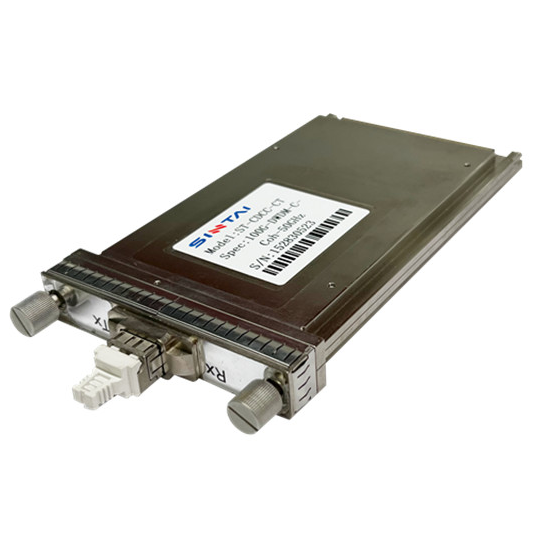
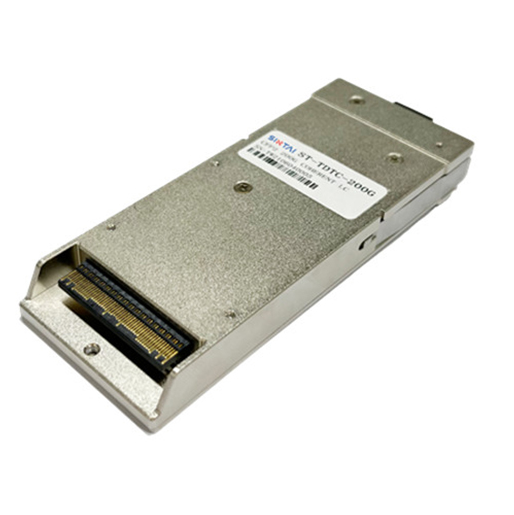
A cfp module in coherent CFP2-DCO form addresses this problem at its source. By integrating digital coherent optics, DSP-based signal processing, tunable C-band laser capability, and OTN processing into a single pluggable module, the CFP2-DCO eliminates the need for many of the external compensation devices that non-coherent approaches require — reducing equipment stacking, simplifying network architecture, and improving the total lifecycle economics of long-haul 100G and 200G transport. For network planners evaluating a cfp2 transceiver for core network upgrades, Sintai's CFP and CFP2 portfolio includes 100G CFP-DCO, 100G CFP2, 200G CFP2-DCO, and 400G CFP2-DCO options designed for optical transport and data center interconnection scenarios across metro, long-haul, and backbone applications.
This guide covers the complete technical and commercial picture: why non-coherent optics fall short in 2026 core network scenarios, how CFP2-DCO technology solves dispersion and OSNR challenges through integrated DSP, what components make a coherent CFP module cost-effective compared with traditional approaches, how CFP2-DCO compares to QSFP28 for long-haul transport, and what deployment and maintenance practices protect optical performance over the network's service life. Secondary keywords relevant to this decision — CFP2-DCO vs QSFP28, 100G CFP2 coherent transceiver, long-haul optical transport, and Sintai CFP2 module price — are addressed throughout.
The starting point for understanding why CFP2-DCO has become the preferred choice for core network upgrades in 2026 is a clear picture of what non-coherent optics actually struggle with — and why those struggles translate into real financial and operational costs that accumulate over the network's service life.
Non-coherent optical modules are designed for applications where the fiber distance is short enough that chromatic dispersion and OSNR degradation remain within manageable limits without active compensation. For intra-data center links, campus interconnections, and short metro spans, this works well. The modules are relatively simple, the fiber plant requirements are straightforward, and the total system cost is predictable.
The problem emerges when operators attempt to extend non-coherent optics into cross-city, metro, and long-haul transport scenarios. At these distances, chromatic dispersion accumulates to levels that cause significant signal degradation — the different frequency components of the optical signal travel at slightly different speeds through the fiber, causing the signal pulses to spread and overlap in a way that increases bit error rates. Polarization mode dispersion adds a second impairment mechanism. And the optical signal-to-noise ratio degrades as the signal travels further from the transmitter, requiring amplification that introduces its own noise contribution.
To compensate for these impairments, non-coherent long-haul systems typically require dispersion compensation modules — passive optical devices that introduce negative dispersion to counteract the positive dispersion accumulated in the transmission fiber. They may also require additional amplification stages, optical regeneration equipment at intermediate points along the route, and careful optical power budget management that constrains the network design. Each of these additional devices consumes rack space, draws power, introduces insertion loss, adds latency, and requires maintenance — costs that are not visible in the per-module price of the non-coherent optic itself but that accumulate significantly across a core network with multiple long-haul routes.
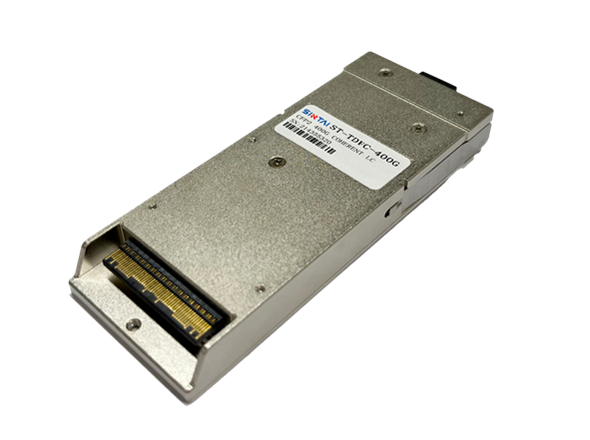
A cfp module is a pluggable optical transceiver form factor used for high-speed optical communication. The CFP form factor — C Form-factor Pluggable — was developed specifically for high-speed applications where the power and thermal requirements of coherent DSP processing exceed what smaller form factors like QSFP28 can accommodate. In coherent DCO versions, the CFP module integrates digital coherent optics — coherent modulation, DSP-based signal processing, and tunable laser capability — into a single pluggable unit that can be inserted into a compatible line card or platform.
The commercial significance of this integration is that it moves the dispersion compensation and signal recovery functions from external rack-mounted devices into the module itself. A cfp2 transceiver in DCO form can compensate for chromatic dispersion electronically through its DSP, without requiring a separate dispersion compensation module in the fiber path. This integration reduces the number of devices in the optical chain, which reduces rack space, power consumption, insertion loss, latency, and maintenance complexity — all of which contribute to the total lifecycle cost of the transport system.

Understanding the technical mechanism by which a CFP2-DCO module compensates for fiber impairments — and why this mechanism is more efficient than external compensation approaches — is essential for evaluating the cost and performance claims of coherent cfp module technology.
The signal processing sequence in a CFP2-DCO module follows a well-defined path that addresses each of the major fiber impairment mechanisms:
Client-side traffic — 100GE, OTU4, or other supported interface formats — enters the cfp2 transceiver through its client-side interface. The module maps this traffic into a high-speed optical transport signal using OTN framing, which adds overhead for performance monitoring, fault management, and forward error correction. The OTN signal is then modulated onto the optical carrier using coherent modulation — DP-QPSK, DP-8QAM, or DP-16QAM depending on the distance and capacity requirement — which encodes information in both the amplitude and phase of the optical signal, dramatically improving spectral efficiency compared with direct-detect modulation. The built-in DSP processes the modulated signal before transmission, applying pre-compensation for known fiber characteristics, and applies forward error correction coding that allows the receiver to correct bit errors that occur during transmission. The line-side DWDM signal is transmitted over the metro or long-haul fiber route on a specific C-band wavelength selected from the module's tunable range. At the far end, a second CFP2-DCO module receives the signal, and its DSP performs electronic dispersion compensation, polarization tracking, and FEC decoding to recover the original client-side signal with high fidelity.
The electronic dispersion compensation performed by the CFP2-DCO's DSP can compensate for the chromatic dispersion accumulated over hundreds or thousands of kilometers of standard single-mode fiber — without requiring any passive dispersion compensation fiber or dispersion compensation modules in the optical path. Sintai's 200G CFP2-DCO supports transmission distances up to 1200 kilometers with optimized DSP algorithms and low-latency SD-FEC, which means that for most metro and regional long-haul routes, the module's built-in DSP provides adequate dispersion compensation without external DCM.
This elimination of external DCM has several important practical consequences. The optical path between amplifier stages is simplified — no DCM insertion loss to compensate for, no DCM rack space to allocate, no DCM procurement and inventory to manage. The amplifier design is simplified because the DCM insertion loss is no longer a variable in the optical power budget. And the latency of the optical path is reduced because the signal does not pass through the additional fiber length of a DCM spool.
Sintai's 100G CFP-DCO supports DP-DQPSK modulation, C-band tunability with 50GHz and 100GHz spacing, and compatibility with 100GE and OTU4 interfaces — providing a mature coherent option for 100G long-haul transport applications. The 200G CFP2-DCO supports DP-QPSK, DP-8QAM, and DP-16QAM modulation formats, full C-band tunability, built-in client-side and line-side OTN processing, optimized DSP algorithms, up to 1200km transmission distance, hot-plug electrical packaging, and low-latency GFEC and SD-FEC — making it the most technically capable option in the range for demanding long-haul and metro DCI applications. The 400G CFP2-DCO extends this capability further with 100G to 400G programmable operation, flexible client interfaces, built-in OTN processing, and low-latency SD-FEC for next-generation core network applications.
A coherent cfp module is not simply an optical interface — it is a highly integrated device that combines multiple functions previously requiring separate hardware into a single pluggable unit. Understanding what each integrated function replaces — and what that replacement means for total system cost — is the key to evaluating the financial case for CFP2-DCO against traditional non-coherent approaches.
Coherent Modulation Engine
The coherent modulation capability of the CFP2-DCO — DP-QPSK for longer distances, DP-8QAM and DP-16QAM for higher spectral efficiency at shorter distances — provides the fundamental performance advantage over non-coherent optics in long-haul scenarios. Coherent modulation encodes information in both the amplitude and phase of the optical signal, achieving spectral efficiency that allows 200G to be transmitted on a single 50GHz DWDM channel — something that non-coherent modulation cannot achieve. This spectral efficiency directly reduces the number of wavelengths and fiber capacity consumed per unit of transported bandwidth.
Built-In DSP for Electronic Dispersion Compensation
The integrated DSP is the component that eliminates the need for external dispersion compensation modules in most metro and long-haul designs. By performing electronic compensation of chromatic dispersion and polarization mode dispersion in the digital domain, the DSP removes the requirement for passive optical compensation devices that add insertion loss, rack space, and cost to the optical path. For a core network with multiple long-haul routes, the elimination of DCM across all routes represents a significant reduction in total system cost that is not captured in a simple per-module price comparison.
Tunable C-Band Laser
The tunable C-band laser in the CFP2-DCO allows a single module type to be configured for any wavelength in the C-band — rather than requiring a separate module SKU for each DWDM channel. This tunability simplifies inventory management, reduces the number of spare module types that must be stocked, and provides flexibility to reassign wavelengths as network traffic patterns change. For network operators managing large core networks with many DWDM routes, the inventory simplification benefit of tunable modules is a meaningful operational cost reduction.
OTN Processing
The built-in OTN processing in the CFP2-DCO provides carrier-grade service transport with standardized framing, overhead, and performance monitoring that allows the module to interoperate with OTN network management systems and to provide per-service performance visibility. This OTN capability is particularly important for operators who need to provide service-level guarantees on the transported traffic — financial private lines, carrier Ethernet services, and enterprise WAN connections where performance monitoring and fault management are contractual requirements.
Forward Error Correction
The FEC function in the CFP2-DCO — both GFEC and SD-FEC depending on the configuration — improves the effective OSNR tolerance of the optical link by allowing the receiver to correct bit errors that occur during transmission. This improved OSNR tolerance extends the reach of the module and reduces the amplification requirements for long-haul routes, which in turn reduces the number of amplifier stages needed and the associated cost and complexity.
| Component / Function | Role in CFP2-DCO | Buyer Value |
|---|---|---|
| Coherent modulation | Improves long-distance signal performance and spectral efficiency | Supports metro and long-haul links on fewer wavelengths |
| Built-in DSP | Electronically compensates dispersion and polarization impairments | Reduces or eliminates external DCM requirement |
| Tunable C-band laser | Supports flexible DWDM wavelength assignment | Simplifies inventory and wavelength planning |
| OTN processing | Supports carrier-grade service transport and monitoring | Improves manageability and service visibility |
| FEC function | Improves OSNR tolerance and transmission reliability | Extends reach and reduces amplifier requirements |
| Hot-pluggable package | Enables replacement and upgrade without chassis downtime | Reduces service disruption risk during maintenance |
| Dual LC interface | Simplifies optical connectivity | Supports standard optical cabling infrastructure |
The comparison between CFP2-DCO and QSFP28 for core network applications is one of the most common evaluation questions that network planners face in 2026 — and the answer depends critically on the specific application scenario rather than on a simple comparison of module specifications or price.
QSFP28 is an excellent choice for its intended application: high-density, short-reach 100G Ethernet connectivity in data center environments where port density, power efficiency, and compact form factor are the primary design drivers. For intra-data center links, top-of-rack to aggregation connections, and campus-scale Ethernet applications, QSFP28 provides the right combination of performance and economics.
The comparison changes fundamentally when the application moves to cross-city, metro, and long-haul transport. QSFP28 modules in direct-detect form are not designed for coherent transmission — they lack the DSP, coherent modulation, and tunable laser capability that long-haul transport requires. Coherent QSFP28 variants exist, but their power and thermal constraints limit the DSP capability and transmission reach compared with the CFP2 form factor, which was specifically designed to accommodate the higher power requirements of full-capability coherent DSP processing.
| Option | Best Application | Primary Advantage | Key Consideration |
|---|---|---|---|
| CFP2-DCO | Metro DCI, long-haul backbone, carrier OTN, financial private line | Coherent DSP, tunable DWDM, OTN processing, up to 1200km reach | Requires coherent-capable platform and wavelength planning |
| 100G CFP-DCO | 100G coherent DWDM transport, mature network upgrades | Proven coherent technology, C-band tunability, OTU4 and 100GE support | Larger form factor than CFP2 |
| QSFP28 | Short-reach 100G Ethernet, high-density data center links | High port density, compact size, lower power for short reach | Not suitable for long-haul coherent transport |
| Non-coherent 100G optics | Short to medium reach links with adequate fiber resources | Lower module complexity for short distances | Requires external DCM and regeneration for longer routes |
The financial comparison between CFP2-DCO and non-coherent approaches for long-haul transport must account for the total system cost — not just the Sintai CFP2 module price in isolation. When the cost of external DCM equipment, additional amplifier stages, regeneration nodes, rack space, power consumption, and maintenance labor is included in the comparison, the integrated CFP2-DCO approach frequently delivers better total lifecycle economics than a non-coherent system with external compensation.
The specific financial advantage depends on the route distance, the number of routes in the network, and the current cost of rack space and power at the sites involved. For operators with multiple long-haul routes where DCM would otherwise be required at every amplifier site, the elimination of DCM across the network can represent a significant capital and operational cost reduction that more than offsets the higher per-module cost of the coherent CFP2-DCO compared with a non-coherent alternative.
The 100G CFP2 coherent transceiver and 200G CFP2-DCO are most valuable in applications where long-haul optical transport performance, low latency, and operational simplicity are primary requirements: carrier backbone networks connecting major cities, financial institution private lines where latency and reliability are contractual requirements, cloud platform DCI routes between geographically separated data centers, 5G and 6G transport networks requiring high-capacity low-latency backhaul, enterprise WAN connections over leased dark fiber, and broadcast and media networks requiring high-capacity reliable transport for live content distribution.
Deploying a CFP2-DCO system that delivers the performance and lifecycle economics that 2026 core network requirements demand involves careful pre-deployment planning, systematic optical design validation, and ongoing maintenance practices that protect optical performance as the network ages and traffic grows.
Before selecting a cfp module for a core network upgrade, network planners should confirm the following:
Establish the required service rate: 100G, 200G, or future 400G — and confirm whether the selected module supports programmable rate operation for future upgrades
Define the application type: metro DCI, long-haul backbone, carrier OTN transport, financial private line, or cloud interconnect — as each has different latency, reach, and OTN requirements
Measure the fiber route distance and calculate the total span loss — confirm whether the CFP2-DCO's built-in DSP can compensate for the accumulated dispersion without external DCM
Assess chromatic dispersion and polarization mode dispersion conditions on the specific fiber plant — older fiber may have higher PMD that affects coherent module reach
Calculate the OSNR budget for the route — confirm that the amplifier design and span loss allow adequate OSNR at the receiver for the selected modulation format
Confirm whether external DCM can be eliminated or reduced based on the CFP2-DCO's DSP compensation capability — and quantify the cost saving if DCM is removed
Identify the required client-side interfaces: 100GE, OTU4, OTUCn, FlexO, or other formats — and confirm that the selected module supports them
Select the appropriate modulation format: DP-QPSK for longer distances with lower OSNR, DP-8QAM or DP-16QAM for shorter distances with higher spectral efficiency
Confirm FEC mode and latency requirements — SD-FEC provides better OSNR tolerance but may add latency compared with GFEC
Verify compatibility between the cfp2 transceiver and the existing OTN or DWDM platform chassis
Calculate the total project cost including optics, chassis, amplifiers, power, rack space, and maintenance — and compare against the Sintai CFP2 module price in the context of total lifecycle economics rather than per-module cost alone
Engage Sintai's technical team to validate the optical design before procurement commitment
Monitor optical power levels, OSNR, pre-FEC bit error rate, post-FEC bit error rate, FEC correction counts, and module temperature through the network management system at regular intervals — early detection of performance degradation prevents service interruptions
Keep module firmware records and platform compatibility documentation current — firmware updates may improve DSP performance or add support for new modulation formats
Clean LC connectors before every installation, replacement, or reconnection — connector contamination is a common cause of optical power loss in coherent systems where OSNR margins are carefully managed
Label all wavelengths, client ports, line ports, fiber routes, and service mappings clearly — accurate documentation is essential for fast troubleshooting in coherent DWDM systems where multiple services share the same fiber
Avoid unnecessary insertion and removal of pluggable coherent modules — each insertion cycle adds wear to the electrical and optical connectors
Check alarms through the network management system regularly and investigate pre-FEC BER trends before they reach post-FEC failure thresholds
Maintain spare CFP2-DCO modules for critical core routes — having spares available reduces the mean time to restore service after a module failure
Recalculate the optical power budget before adding new wavelengths or changing modulation formats — adding channels or changing to higher-order modulation affects the OSNR available for each channel
Document service mapping, wavelength allocation, modulation format, FEC mode, and optical power baselines for each route — this documentation supports capacity planning, failure analysis, and future upgrade decisions
In 2026, the financial case for coherent CFP module technology in core network upgrades is stronger than it has ever been. The combination of AI traffic growth, cloud interconnection expansion, and 5G transport evolution is pushing bandwidth requirements on long-haul routes to levels that non-coherent optics cannot serve efficiently — and the hidden costs of external dispersion compensation, additional amplification, and optical regeneration that non-coherent approaches require are becoming increasingly difficult to justify when integrated CFP2-DCO technology can eliminate many of these devices entirely.
A 100G CFP2 coherent transceiver or 200G CFP2-DCO from Sintai integrates coherent modulation, DSP-based electronic dispersion compensation, tunable C-band laser capability, OTN processing, and forward error correction into a single pluggable module — reducing equipment stacking, simplifying optical design, lowering latency, and improving the total lifecycle economics of long-haul optical transport compared with traditional non-coherent approaches. For operators evaluating CFP2-DCO vs QSFP28 for core network applications, the technical and financial advantages of the coherent CFP2 form factor for metro, long-haul, and backbone transport are clear and quantifiable.
Sintai provides CFP and CFP2 transceiver options as part of its optical transport portfolio — including 100G CFP-DCO, 100G CFP2, 200G CFP2-DCO, and 400G CFP2-DCO products — for data center, telecom, broadcast, private network, and enterprise optical networking applications across metro, long-haul, and backbone scenarios.
Contact Sintai today to share your core network route distance, bandwidth target, fiber plant characteristics, and latency requirements. The Sintai technical team can help you compare CFP2-DCO vs QSFP28 for your specific application, evaluate 100G and 200G coherent upgrade options, calculate the total lifecycle cost advantage of eliminating external DCM, and provide a Sintai CFP2 module price quotation based on your route design and capacity plan.
Q1: What is a CFP module and how does it differ from standard optical transceivers?
A cfp module — C Form-factor Pluggable — is a high-speed pluggable optical transceiver form factor designed for applications where the power and thermal requirements of high-speed signal processing exceed what smaller form factors can accommodate. In coherent DCO versions such as CFP-DCO and CFP2-DCO, the module integrates digital coherent optics including coherent modulation, DSP-based signal processing, tunable laser capability, and OTN processing into a single pluggable unit. This integration distinguishes coherent CFP modules from standard direct-detect transceivers, which lack the DSP and coherent modulation capability needed for long-haul optical transport.
Q2: What is a CFP2-DCO transceiver and why is it used for long-haul transport?
A cfp2 transceiver in DCO form integrates digital coherent optics — coherent modulation, DSP-based electronic dispersion compensation, tunable C-band laser, OTN processing, and forward error correction — into a single pluggable module. It is used for long-haul optical transport because its built-in DSP can compensate for the chromatic dispersion and polarization mode dispersion that accumulate over long fiber spans, eliminating the need for external dispersion compensation modules in many network designs. Sintai's 200G CFP2-DCO supports transmission distances up to 1200 kilometers with optimized DSP algorithms and low-latency SD-FEC, making it suitable for demanding metro and long-haul core network applications.
Q3: CFP2-DCO vs QSFP28 — which is better for core network long-haul transport?
For short-reach data center and campus applications where port density and compact form factor are the primary requirements, QSFP28 is an excellent choice. For cross-city, metro, and long-haul transport where coherent modulation, DSP-based dispersion compensation, tunable DWDM, and OTN processing are required, CFP2-DCO provides significantly better performance and total lifecycle economics. The CFP2 form factor accommodates the higher power requirements of full-capability coherent DSP processing that QSFP28's thermal constraints limit, making CFP2-DCO the technically appropriate choice for long-haul optical transport applications where QSFP28 direct-detect modules would require external compensation equipment.
Q4: How does CFP2-DCO reduce total network cost compared with non-coherent approaches?
CFP2-DCO reduces total network cost by integrating the dispersion compensation, coherent modulation, and OTN processing functions that non-coherent approaches require from separate external devices into a single pluggable module. This integration eliminates the rack space, power consumption, insertion loss, latency, and maintenance cost of external dispersion compensation modules across all long-haul routes in the network. When the Sintai CFP2 module price is evaluated in the context of total lifecycle cost — including the cost of external DCM, additional amplifier stages, rack space, power, and maintenance that non-coherent approaches require — the CFP2-DCO approach frequently delivers better financial efficiency for metro and long-haul transport applications.
Q5: What should buyers confirm before requesting a Sintai CFP2 module price quotation?
Buyers should confirm the required transmission distance and fiber route span loss, the chromatic dispersion and PMD characteristics of the fiber plant, the OSNR budget for the route and amplifier design, the required service rate and client-side interface format, the appropriate modulation format for the distance and capacity requirement, the FEC mode and latency requirements, the compatibility between the cfp2 transceiver and the existing platform chassis, and the future upgrade plans — including whether 400G programmable operation will be needed. Providing this information to Sintai's technical team allows them to recommend the most appropriate CFP module configuration and provide an accurate quotation based on the specific route design and capacity plan.



 English
  русский
  Indonesia
  Español
  português
  العربية
  français
  Deutsch
  हिंदी
हिंदी  tiếng việt



-3.webp "Channel Monitoring (OCM)")